Cooking with the TV On: The Battle for Reality in Domestic Life

In the last year, the Covid-19 virus introduced not only higher levels of isolation, unemployment, instability, and anxiety for our culture but it also had an effect on our use of time. With quarantines, lock-downs, social distancing and travel advisories, we found our daily routines upset and our habits changed. With more time at home, some turned to cooking, cleaning, renovating, and artistic hobbies to ease their boredom and loss of normalcy, while others streamed Netflix for hours, marathoned movies, and filled the void of people, work, and noise with television, social media, and the news.I myself was not immune to the havoc this virus wrecked upon habits and normalcy in the last ten months. I found myself spending more evenings streaming a Netflix original or watching White Collar with my aunt after dinner. I also found myself spending my days cleaning, cooking, and folding laundry wondering when the house would once again fill with people and my day with plans.While I did of course watch television before March 2020 and I had already an intense love for domestic life, one particular habit in my life that developed over this past summer brought these two activities together: watching TV while cooking. I often found myself in the kitchen preparing my dinner for one with a television show on my laptop a few counters away, keeping me “company” while I steamed fresh kale, sautéd chopped onions, cooked Italian chicken, or baked fudge-y brownies for the tenth time. Ever so often, I would catch myself in the midst of this scene and wonder:
“Why can’t I just cook without the accompanying voices of Frasier, the Gilmore Girls, or Full House on in the background?” Why do I fill the deafening silence of my apartment with the color and complexity of make-believe lives from a screen?
Soap Operas and Pacifiers
 Turns out, I am not the first or the last woman to choose to include media in their domestic life. Long before streaming services, and even before television was a part of the American household, women would turn the radio on to listen to soap operas. In the book, Communication in History, Sterling says: “by far the most important network dramatic programming, in hours broadcast per week, was the woman’s serial drama, or soap opera” (103).Radio soap operas were easy to tune into at their regular appointed times throughout the week while the woman of the house took care of housework. In the 1940’s, not long before television became the main fixture of most American suburban homes, a trade press observer worried, “the housewife who is accustomed to listening to soap operas while she washes, irons, and does the housework, cannot watch a visual program while she does her chores” (Boddy 225).Little did this observer know that with the emergence of television screens, laptops, tablets, and even smartphones, entertainment would be able to follow us around our homes like a child trails their pacifier and favorite stuffed animal everywhere they go.In order to show that television influences how women view and value domestic life in their own homes, we will look back on the history of television, look presently at the estate of television and domestic life, and finally, look forward to why domestic life should matter to the Church.
Domestic Life is defined as “the home experience” and includes activities such as: doing laundry, washing the dishes, decorating, hosting, cleaning, and cooking.
Radio Paves the Way

To understand the history of television, we must first take a quick look at radio. Radio became the first mass-media for American households delivering news, music, dramatized stories, local weather and traffic updates right into the heart of the home, the living room. Now without reading the newspaper, or waiting for a telegraph or letter, a household could find out what was happening both in their local town and across the Atlantic. The radio was originally intended to be a medium serving as a “wireless telegraph” or “wireless telephone” but instead quickly became a medium of great entertainment.Households could now spend their evenings listening to plays, operas, or sports without having to leave the comfort of their living room. For the first time ever, households were gathering around a media technology that could be tuned into at any time of day, any day of the week, by anyone in the home. While the radio served as a communal evening activity, it also encroached its advertising and entertainment into the workday and workspace of the home. No space of the home was left untouched by its wavelengths, the radio took over the home, like an "omnipresent medium" (Forntale and Mills, 217). But radio was simply making way for an even greater shift in American homes and entertainment.With the habit of sitting and listening to the radio built into a good deal of home experiences, the television quickly found its place in the home as well. By the 1950's, television sets were common in most suburban homes and were "the primary medium for influencing public opinion” (Kammerzelt, 153).
Leisure Welcomes Television
After weathering World War I, the Spanish Flu, the Great Depression and World War II, those alive in the 1950's quickly witnessed the purpose of work in the home move from survival to leisure. The United States was experiencing newfound economic prosperity and for the first time in a long time, everyone was stateside and working. New domestic appliances were being mass-produced for the home while the novelty of pre-prepared food lined grocery store shelves, all with the hopes of "saving time" so that households could enjoy more leisure (Read Home Sweat Home). Within a generation, the work that was once required of a home well-run and a family well-clothed, fed, and cared for was replaced with the ideal affluent goal of leisure. While leisure is a modern invention and often more miserable than a good day's work, leisure is not the issue as much as it is the catalyst of change in the "home experience" and the range of influence the television (and its streaming services) would have on American homes.My own great-grandmother born in 1890 spent her life managing their home and land with great pride and excellence. She did so because without her work and creative thriftiness her family and home would not survive. Her days were full: butchering their meat, canning their garden’s produce, making their clothes, cooking from scratch, washing laundry by hand, and raising six children. By the time her eldest, Mary Louise (b.1924), was a mother herself in the 1960’s, the home front was viewed differently by the surrounding culture. Mary Louise was raising five children while her husband Walter, a chemical engineer and WWII veteran worked at the local paper mill. She was often heard saying to her kids: “your dad goes to work every day and so do I”.
Her youngest daughter, my mother, recalls that, “she considered the home to be her work and her creative domain, she took her role as manager of the home as her work and gave it all the attention and dedication of a real job. She found great joy in bringing chaos into order through ironing, cleaning, and enjoyed creativity in cooking meals from scratch. She also used her house as a creative outlet to explore woodworking, stain glass making, sewing, landscaping, and oil painting.”
But during her years as a stay-at-home mom, especially between 1965-1975, Mary Louise often said she felt like her job was no longer considered important or needed in the eyes of modern culture, to stay home was old-fashioned and to work hard in the home, unnecessary. My mother remembers that my grandmother would sit and watch television every night with them and shows like That Girl (1966-1971) and Mary Tyler Moore Show (1970-1977) would come on. These shows showed the new ideal for women as single, independent, beautiful, fit women, who owned great apartments, had sex without marriage or kids, and were autonomous, pursuing their careers. After watching these shows, my grandmother would often come away feeling useless or worthless. The message she was receiving from television was that to be a successful and affluent woman she needed to take shortcuts in the home and to care less for the creative and mundane details of domestic life. Her reality was not well represented in what she watched, and she often felt out of sync with her time period and its values. If a few shows from the 1960's could frustrate the way my grandmother viewed and valued her home experience, how much more today? So how did television become such an influential voice in the home?
Rearranging the Home
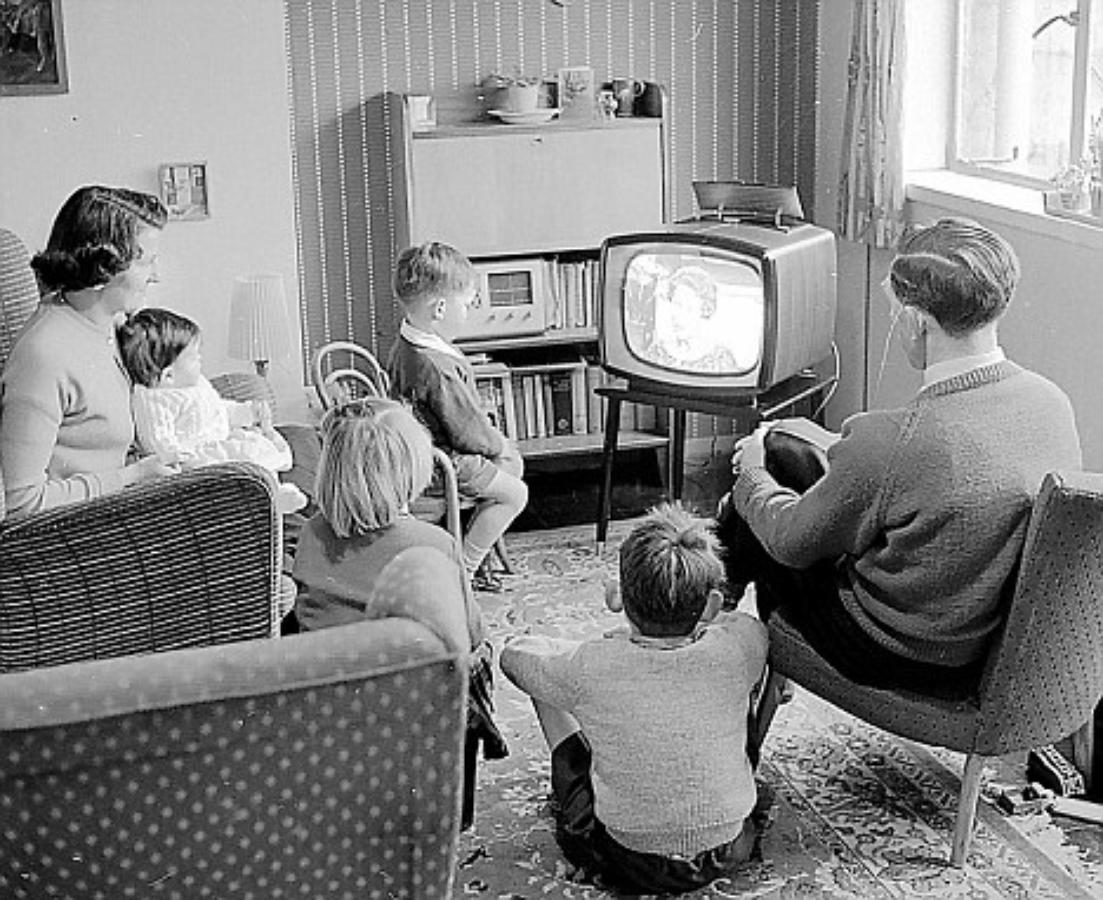
Television sets were marketed as the newfound core of the home experience. They replaced the fireplace and the dinner table in advertising campaigns, television sets, and in the practice of so many American homes (see the 1951 issue of American Home). Consider the TV tray phenomenon? How many families gather around their meals with the TV on nowadays? Or stream the latest episodes of their favorite show while eating? This all started 70+ years ago.Think of examples today: when you walk into someone’s living room is the furniture arranged around the TV screen? When you walk by homes or apartment buildings at night what shines through into the dark night? When you go into a den (place of leisure) or a bedroom (a place of rest), or a living room (a place for community and conversation), what is often affixed to the wall or sitting prominently in the middle of the room? Television screens. This is not even counting the myriad of devices strewn across each room (laptops, smartphones, Apple watches, and tables). If the ever-available television (and its streaming services...Netflix, Hulu, Amazon Prime, Disney+) has stayed over like an uninvited guest to our dinner time, our kids playtime, our evening conversation time, and even our sleep, is it not also commandeering our understanding of reality?Television is not a neutral medium. When television entered the home, it changed everything. Just like radio. It creates new habits for the human and effects change in our known realities. Marshall McLuhan, a media theorist, coined the phrase, “the medium is the message” (Understanding Media: The Extensions of Man, 1965). What he meant by this is the mediums we interact with every day: billboards, social media, conversation, books, newspapers, art, music, and video all have an effect on us. Television is no different. Television has been and is predisposed towards entertainment no matter the content placed within its screen. Why does it matter if television is entertainment? There is certainly nothing wrong with good entertainment, but the issue comes with how television affects its content, and inevitably its audience. Neil Postman said it well in his book Amusing Ourselves to Death (1985):
“what I am claiming here is not that television is entertaining but that it has made entertainment itself the natural format for the representation of all experience…the problem is not that television presents us with entertaining subject matter but that all subject matter is presented as entertaining” (87).
The bias towards entertainment is unavoidable. To explore this idea even more, go read Neil Postman’s book: Amusing Ourselves to Death: Public Discourse in the Age of Show Business.. To exemplify the bias towards entertainment in television, let’s consider the concept of sensationalism and how that affects domestic life.Sensationalism is defined by media ecologists as created media that either presents an unreal and unattainable reality (airbrushing the truth and the mundane) or is over-dramatized to shock, entertain, and move audiences to certain emotions. Simply put, sensationalism in television is often in television series that represent picture-perfect realities, chaotic realities, or life without consequences—all attempting to entertain and make the audience feel a wide range of emotions. Sensationalism promotes the ideal and subtlety creates a fear or distaste for the mundane.
Breakfast Scenes and Airbrushed TV
One hilarious example of sensationalism in film and TV can be found in the clip, “Frog at Breakfast” in Cheaper by the Dozen. While there might be a few families who can relate to such a display of utter chaos and destruction at the breakfast table; the scene is most certainly absurd and over dramatized. This is but one of thousands of television scenes where the story is embellished for entertainment’s sake. While not all television series or sitcoms are such blatant examples of sensationalism, television’s most subtle yet pervasive tool is including sensationalized plot lines, characters, or representations of life in such a way that the viewer does not notice they are even there. Life is represented just enough to be relatable to its audience but then includes messages about life, community, and home that are unrealistic. Sensationalism sneaks into the subconscious of the viewer who begins to unknowingly hold expectations for life that are an actual denial of genuine reality. Consider the show Friends (1994-2004), three men and three women living in close proximity as friends enjoying all the "benefits" of life without any of the consequences. Sex without STD, abortion, or drama. Friendship without accountability, selflessness, sacrifice, or trust. While the show is no doubt entertaining, it is harmfully unrealistic. Friends presents a reality that is void of consequences and in profound contrast to the communal values presented in Scripture. The show appeals to our flesh and our pride (1 John 2:16).Another example of sensationalism is The Hallmark Channel. This TV channel has been infamous over the years for creating television series and films (When Calls the Heart, Chesapeake Shores, or their Christmas Countdown) which are focused on family, small town life, and community but their homes, kitchens, and familial relationships are often absolutely picture-perfect and unattainable.Sensationalism is even found in cult-classic TV shows such as the Gilmore Girls. This show follows a single-mother and her teenage daughter through eight years of school, career, and relationships in a small town in Connecticut. One aspect of the show that has always struck me as unrealistic is the amount and the kind of food that Lorelai and Rory Gilmore consume on a daily basis (read What Would Happen If You Ate Like A Gilmore Girl). Take a closer look at some of the best food moments in their show to observe their over-exaggerated relationships with food. In reality, the character of Lorelai, Lauren Graham, kept a strict diet every year of Gilmore Girls. Her real life stands in grand contrast to what the screen portrayed.As Jaques Ellul states, people “live on the screen a life they will never live in fact,” because ideals and entertainment are represented as achievable when in fact they are not--choices have consequences, sin does destroy, life is messy, and the mundane is precious.
Tell It Like It Is
 The Brady Bunch a sitcom airing from 1969 to 1974 follows the lives of a blended family of six kids and a housekeeper. In one particular episode, “Tell It Like It Is,” Carol decides to submit an article to a magazine about her family’s life. The magazine editor rejects her submission. When her husband Mike confronts the editor as to why, he responds with, “Tomorrow’s Woman likes to accentuate the positive, the pleasant side of things,” to which Mike responds, “You mean, not tell it like it is?” The editor then replies: “Mr. Brady, today’s world is grim enough. In Tomorrow’s Woman, we’re looking for happy angles in life stories, not exactly rose-colored glasses”. Carol then rewrites the story emphasizing only the positive and happy aspects of their family life and re-submits it. However, when the reviewers visit her family and read her story, they are shocked by how unlike they are to what she described in her article. They tell her that they want the original version to be published where it describes a normal family and its problems. Before going to find the sandwiches Alice made in the kitchen, the reviewers leave Carol with these words of advice:
“The truth is not only stranger than fiction, but far more interesting to the average reader. Tell it like it is”.
This episode exemplifies how sentimentality and reality are not usually synonymous. Readers (and viewers) want to know there are people out there just like them, living day to day. Most television does not provide representation to people’s actual, feasible, and ordinary lives. That is not to say people do not relate to television shows. We create what we know, but we also tend to create what we wish were true: the ideal, the dramatic and the heroic. These simply do not reflect the lives we live.
Netflix and Stars Hollow
 In one final attempt to explore the history and content of television, let us look at a very influential show for women of all ages from the early 2000’s: Gilmore Girls. This show premiered in October 2000 before 9/11 and ended in May 2007 just as the smartphone and Netflix were becoming widely accessible. In fact, Gilmore Girls owes much of its fan club to Netflix who has been streaming the show since 2014. The myriad of female characters in this show is astounding as they are each distinct, colorful, complex and relatable. Each of these women have a domestic life in the show but view, value, and engage with it differently.First, there is Emily Gilmore, the upper-class grandmother whose life revolves around social engagements, the DAR, and supporting her husband, Richard, who works for an insurance company. Emily does not do her own housework; she employs a maid and is never capable of keeping one for long because she is demanding and particular about how her home is run. In a few episodes Emily expresses how she feels her worth is called into question because she does not work outside the house. Important to note, she also does not really work inside the home either.Next is Lorelai, her 30-something single daughter, who owns a house with a yard. Lorelai also owns and runs an inn. While she is seen to care about every detail regarding the “home experience” of her inn, she is not invested in her own domestic life or home experience. She is quick to lovingly criticize her daughter Rory when Rory dresses up like Donna Reed (see The Donna Reed Show), she eats only junk food and take-out, spends most of her time home in front of the TV with her daughter, and when she cleans up for guests, often tosses magazines or clothes into closets.Rory her teenage daughter, joins her mom in her lack of cooking, cleaning, and creative hospitality. Her life has one goal, go to Yale and become a journalist. Her mother is clear that this is what matters most in life. Lastly, Sookie St. James, Lorelai's best friend is a phenomenal chef for the inn but is often so engrossed in her work at the inn’s kitchen that her own home is chaotic and neglected, and she often appears somewhat ignorant of how to properly manage her home and children.While this is just a glimpse of the female characters on the Gilmore Girls, it is fascinating to observe the potential different messages being communicated through these characters and their choices regarding their homes.
Distracted From Living: Longing for Life.
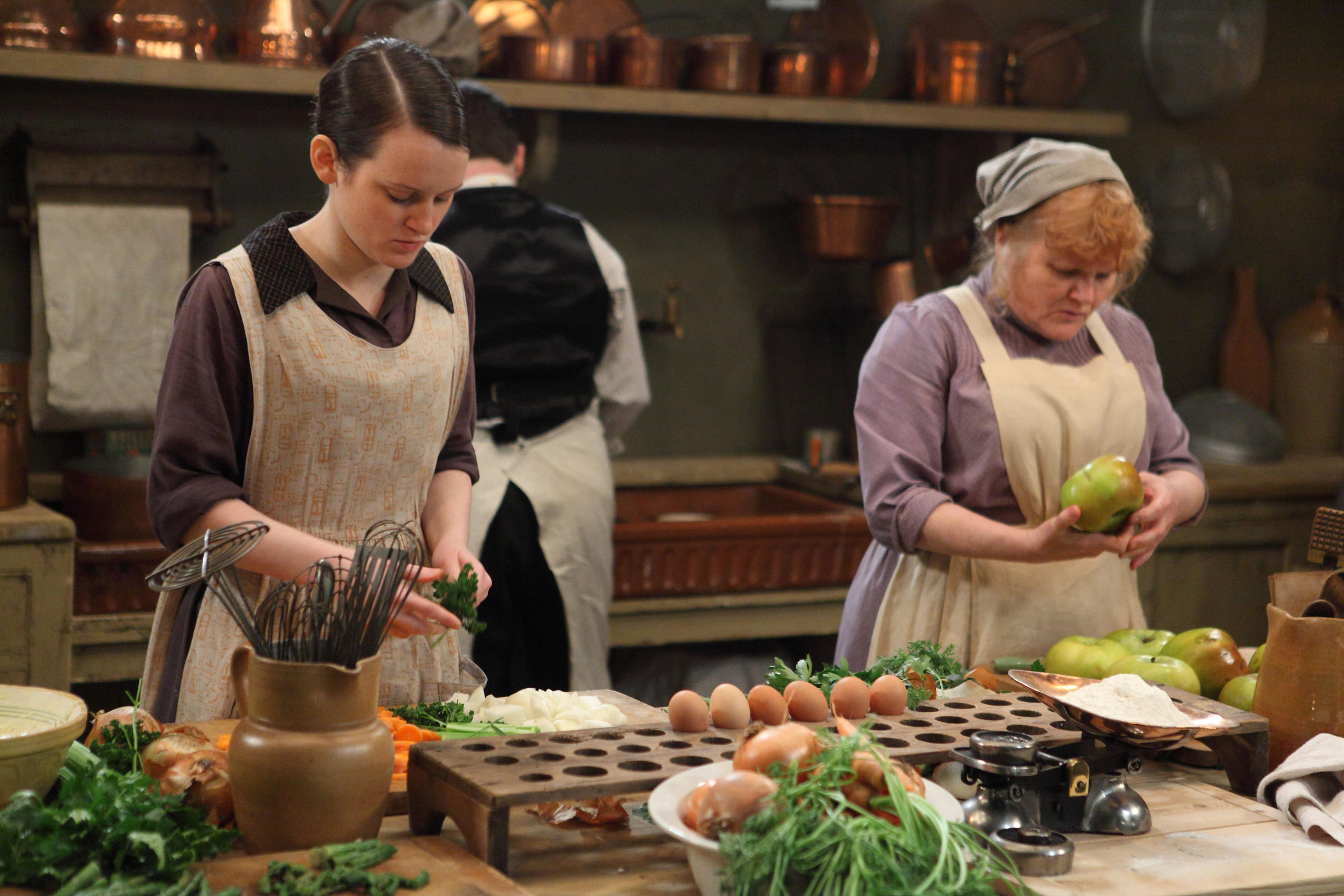 So how does television influence the modern home and domestic life? First, television can simply consume our time and attention at the end of the day or during the afternoon so that the home is but the four walls that our couch and device dwell in…the dishes pile up in the sink, the laundry waits to be folded, and our hosting consists of a remote and some snacks. Second, television can be the “companion” in the room, telling good stories, cracking new jokes, and filling the silence, making the mundane activities of the home more "bearable"…watching Blue Bloods while you clean, putting on Downton Abbey while you cook, or Call the Midwife as you fold laundry. While there is nothing inherently wrong with enjoying a good TV show or movie while working and creating around the home, there are two concerns that arise from these television centered habits in our domestic lives as Christian women and men.
 First, television’s sensational and sentimental entertainment is often far more interesting or appealing to us than doing the next thing that needs to be done in the home. These "lives" on television are the community, energy, comfort, and plot line we so often desire for own lives so why would we want to put that down? But the neglect of tangible and ordinary tasks around the home that God has entrusted to us is short-sighted and quite honestly, unfaithful. Participating in creating a home with God for one's self and community is both a responsibility and a ministry of the body of Christ.Second, television’s ability to follow us around as we work and create in the home strips our work of its own meaning, our minds of their own processing and our hands of their own creativity. This can cause our work and creativity in the home to become simply the backdrop for Hollywood’s story, instead of meaningful, momentous, and culture changing rituals.
This habit of cooking with the TV on makes me wonder whether or not we actually believe our lives are the true lives that are to be lived?
Everything Communicates
You see, it comes down to communications. In short, everything communicates. The way we arrange a room, the way we position our bodies, the habits we sustain, the food we eat, the technology found within the home, and the art on the walls. Domestic life as the home experience is communicative. Everything done, created, and resting in the home communicates something. Second of all, domestic life is inherently creative, it is the art of homemaking.Now, if you are about to disengage because you do not have a domestic life, let us clear something up real fast. Unless you are homeless or in the middle of moving, you have a domestic life. Domestic life is not something one attains after college or once they marry; if you live somewhere then you have a home and a domestic life, whether you like it or not. Unfortunately, homes and domestic lives are often not found to be enjoyable, restful, home-y, safe, or Gospel centered, but that does not take away the fact that most of us have domestic lives that we are supposed to engage with.
The Art of Homemaking: A Theological Task.
The creative act of homemaking is not something that happens in isolation or in chaos, but rather, a making that takes place through ritualistic action and thoughtful engagement with the tasks and duties that come with a home. While the home is not the Church nor is domestic life the liturgy of the Eucharist, the domestic life within a home is a communal and creative act that is meant to manifest the truth and life of the Church and the Gospel to those in the home and to those who are invited to enter into it. Our homes serve as a tangible manifestation of the home the Father and Son make within us (John 14:23) and promise to bring to fulfillment in the second Advent (14:3). In speaking of the body of Christ gathering together, Professor Kammerzelt says:
“when we experience together, we remember together, we recreate reality together, we rebuild, we repair entropy’s spiritual effects. In this way, the role of the church is “anamnesis”—meaning, a lived memory” (55).
While this speaks of the larger gathering of believers on Sunday for the Eucharist, it is manifested on a smaller scale in the home. Whether we live alone, with family, or with roommates, domestic life is God’s gift to us that we might remember, experience, create, and manifest together the One True Reality: the Life of the World, Jesus Christ (For the Life of the World), who gives meaning to all that we have, do, and are. Everything is sacramental, everything belongs to Christ. Our work in the home is a gift.Consider Ecclesiastes, Jesus writes through King Solomon: "Whatever your hand finds to do, do it with your might" (9:10) and "there is nothing better for them than to be joyful and to do good as long as they live, also that everyone should eat and drink and take pleasure in all his toil--this is God's gift to man" (3:12-13).
Manifesting the Gospel: A Battle For Reality.
Masked under the “things we have to do” at home are found rituals and tasks that communicate profoundly. The acts of washing and cleaning speak of renewal, stewardship, and Christ’s work to cleanse us so faithfully and sacrificially. The acts of hosting and setting the table prepare us for the fellowship, the communion, the generosity and equality that will be given to every person at the meal. Cooking and sharing meals with others calls back to the breaking of the Christ’s body, calls presently to the life we share in Him, and calls forward to the Marriage Supper of the Lamb. The act of eating food that took time to prepare reminds us that toil is our curse now and food will never satisfy, but Christ is our Bread and our Living Water. The acts of making a bed or putting away laundry remind the mind and body that to bring back together, to reconcile, to rebuild, to recreate is the privilege and task the Church shares in with Christ Jesus. For Christ is our true home, life, rest, food, and peace. Engaging in domestic life is to remember that all we have, do, and are is found in Him—and to invite the world to share in the beauty, blessing, creativity, and gift that God always intended domestic life to be.
Domestic life is about bringing order to chaos—proclaiming life in death, and spreading Shalom in a weary and evil world (read Communicating for Life by Quentin J. Schultze).
Without a robust theology behind our lives, everything we do will simply mirror the emptiness of the world’s latest trends or movements, forgetting what God called good (Genesis 1-2) and accepting what the world calls benefits. The end goal of our domestic lives will become achieving the expectations, pressures, and unrealistic realities of television, ending only in disappointment. The pinnacle of life will be to unknowingly imitate fictional characters and scripted lives, instead of being the ones creating and changing culture. It is the social conflict over the real. Will the Church manifest Reality or will the world lead in its ever-changing definitions of reality?
Making A Home: Ordinary Creativity
Because television influences the way women and men view and value domestic life in their own homes, habits such as watching television while you cook or binge-watching Netflix instead of cleaning are not always wise, life-giving, and meaningful choices. They rob us of our true ordinary lives and they begin to influence what we believe to be true and good. Without a moment alone with our own thoughts, without silence in which to hear God, without ideas and values from our own local culture, what will our lives most look like? A combination of entertainment's best moments or a reality unlike anything a script can imitate.
So what now? What does a Christian woman or man do with their domestic life?
Andy Crouch in his book, Culture Making, said: “creativity is the only viable source of change” (73). Culture change starts with the smallest actions, what seems to be the most meaningless or mundane tasks. The mundane-ness is but a disguise for how powerful a few new habits are for cultural change. Remember, “the power of the artist lies not in their IQ or their technical skill, but in the strength of their imagination” (Brueggemann, 39). The modern myth is that you need to be an expert before you do something, or that you need to be passionate about your job. That is just not the case. What you do need to be is faithful in the little you have been given and ready to receive the joy waiting for you in the creativity, the job, the ritual, and the beauty of domestic life. As N.T Wright once said, “The arts are not the pretty but irrelevant bits around the border of reality. They are the highways into the center of a reality which cannot be glimpsed, let alone grasped, any other way" (Simply Christian: Why Christianity Makes Sense).Will you join me in the art of homemaking? To live ordinary lives in ordinary homes with creativity and meaningful domestic engagement, that the home would be a place where our common longings await our Lord, where our actions speak of His world, and where our screens become uninvited guests to the work and life of His home with us?
Works Cited
Kammerzelt, Brian. Ministry Media Matters. Moody Bible Institute, 2020.McLuhan, Marshall. Understanding Media; the Extensions of Man. New York, Signet Books, 1966.Patton, Elizabeth and Mimi Choi. Home Sweat Home, Rowman and Littlefield, 2014.Postman, Neil. Amusing Ourselves to Death. Penguin, 2010.Schmemann, Alexander. For the Life of the World. Athens Printing Company, 1963.Wright, N. T. Simply Christian : Why Christianity Makes Sense. 1st ed., HarperSanFrancisco, 2006.